
Posterior Cervical Laminectomy in New Jersey
Posterior cervical laminectomy relieves pressure on the spinal cord through the back of the neck by removing the lamina, the bony arch that covers the spinal canal. Surgeons turn to it when the canal has narrowed, often across several levels, and the cord needs more room to function without compression.


Definition
What is a Posterior Cervical Laminectomy?
Posterior cervical laminectomy is performed through an incision at the back of the neck. The surgeon removes the lamina, the bony arch covering the back of the spinal canal, along with any thickened ligament pressing on the spinal cord. Opening the canal this way gives the cord room to drift back, away from whatever is compressing it in front.
The procedure can stand on its own or be combined with a fusion. When the neck is well aligned and stable, a laminectomy alone may be all that is needed. When there is instability or the spine curves forward, screws and rods are added to keep the neck from drifting out of position over time.
Because it decompresses from behind, the laminectomy is especially useful when the compression spans several levels or when a front-of-neck approach is not the right fit.
How do you know if you need a Posterior Cervical Laminectomy?
Posterior cervical laminectomy usually comes into the conversation when the spinal cord is compressed in the neck and symptoms keep progressing despite conservative care.
It is also considered when the compression spans several levels, or when the source of the pressure sits behind the cord where a front-of-neck approach cannot reach it.
Signs that a posterior cervical laminectomy may be needed include:
- Cervical myelopathy (spinal cord dysfunction) causing hand clumsiness or balance problems
- Cervical stenosis affecting multiple levels
- Ossification of the posterior longitudinal ligament (OPLL)
- A thickened spinal ligament (ligamentum flavum) compressing the cord from behind
- Symptoms that keep progressing despite medications, therapy, or injections
- Tumors or infections compressing the spinal cord
- Cord compression where an anterior approach is not ideal
How do we perform a Posterior Cervical Laminectomy?
01
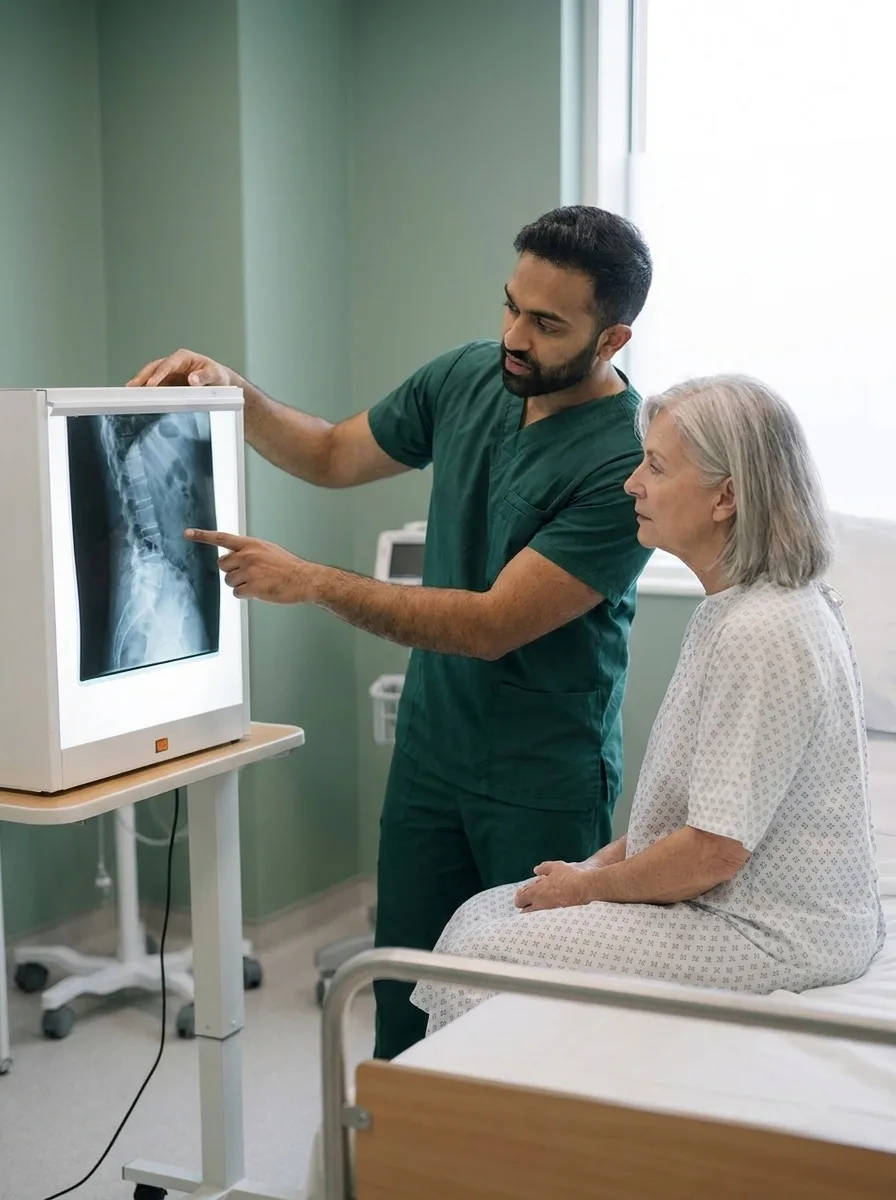
Positioning and surgical exposure
02
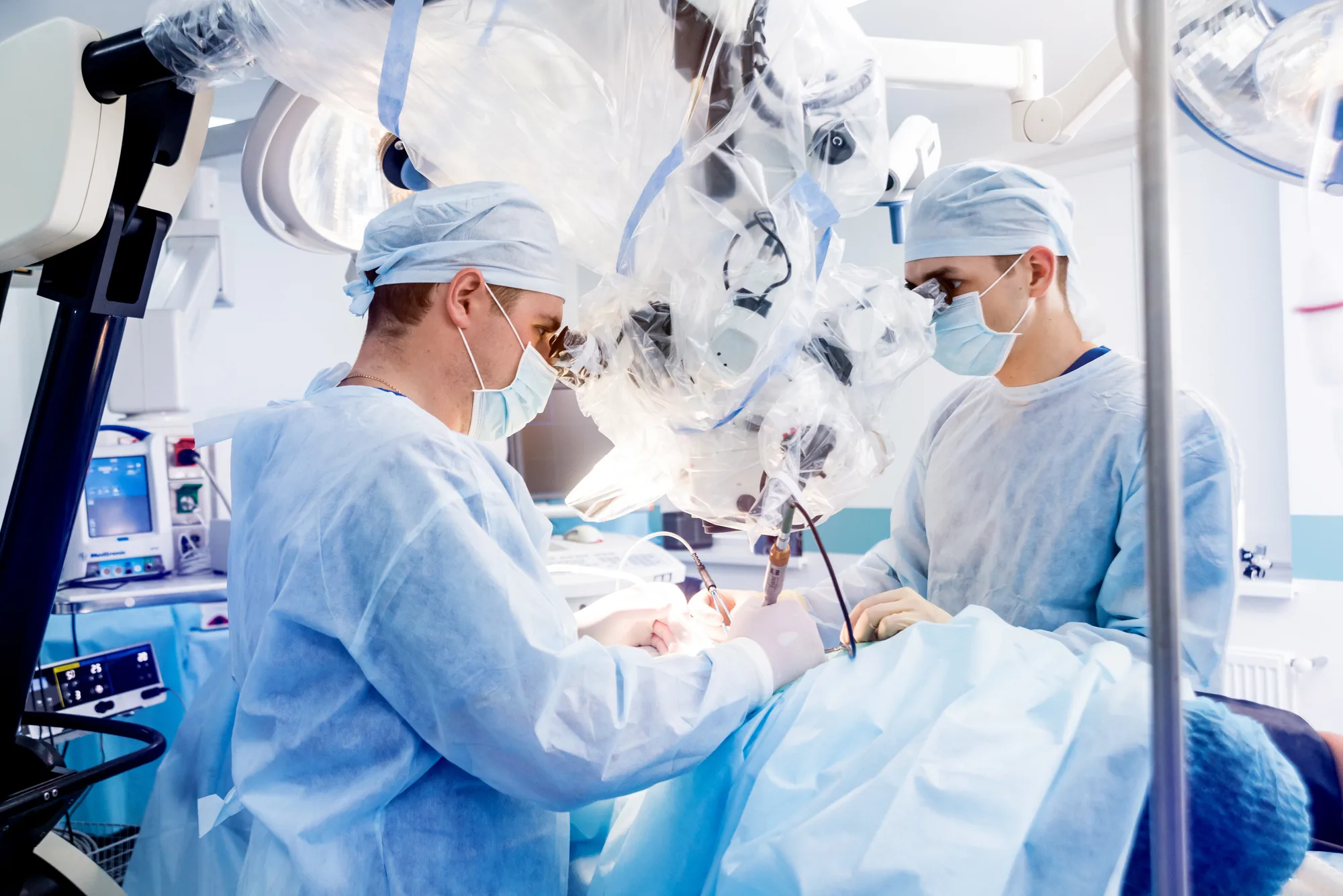
Removing the lamina
03
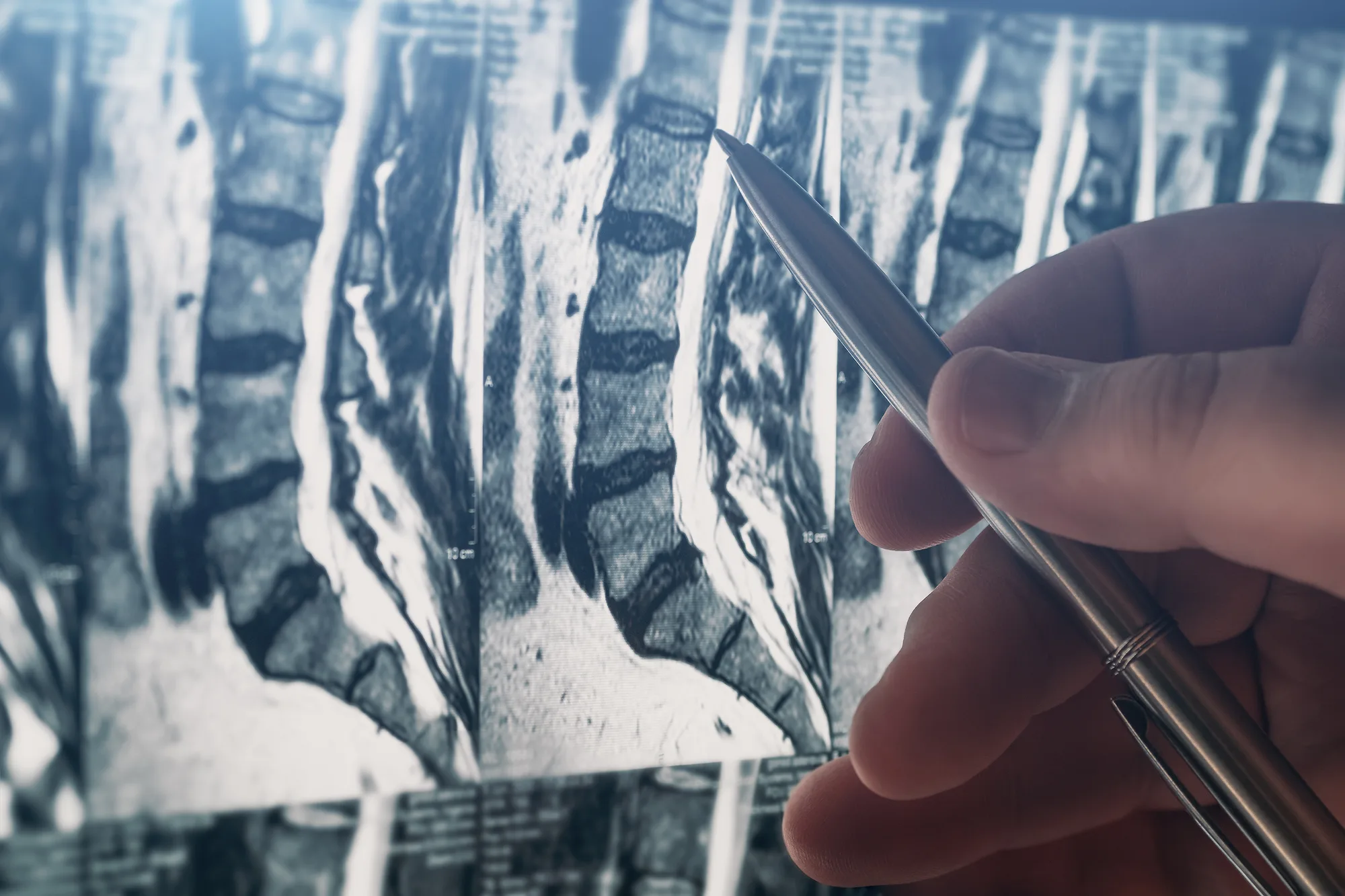
Verification and closure
Recovery
What is recovery like after Posterior Cervical Laminectomy?
Most patients stay in the hospital for one to two days after a posterior cervical laminectomy, longer if a fusion is added. Early on, the focus is on getting up, walking, and letting the surgical area settle.
Light activity comes back within a few weeks, and physical therapy generally begins near the four-week mark to rebuild strength and motion. The main goal of surgery is to stop the myelopathy from getting worse.
Many patients also regain hand function and balance as the cord recovers, though how much depends on how long it was compressed before surgery, and their previous level of disability.
Common conditions that require a Posterior Cervical Laminectomy
Degenerative Disc Disease
Learn about degenerative disc disease treatment in New Jersey for chronic back pain, neck pain, stiffness, and other symptoms caused by age-related disc degeneration.
Disc Herniation
Learn about disc herniation symptoms, causes, diagnosis, and minimally invasive treatment options in New Jersey at The Jey Institute.
Myelopathy
Learn about myelopathy treatment in New Jersey for balance problems, hand coordination changes, weakness, numbness, and other symptoms caused by spinal cord compression
Cervical Radiculopathy
Learn about cervical radiculopathy treatment in New Jersey for neck pain, arm pain, numbness, and other nerve-related symptoms.
Spinal Cord Injury
Learn about myelopathy treatment in New Jersey for balance problems, hand coordination changes, weakness, numbness, and other symptoms caused by spinal cord compression

Dr. Shiveindra Jeyamohan, MD.
Chief Surgeon & Medical Director
Meet the clinical lead
Why choose The Jey Institute for Posterior Cervical Laminectomy?
Choosing a surgeon for posterior cervical laminectomy in New Jersey comes down to more than the procedure itself.
Experience with complex multi-level decompression, surgical volume, and how patients do afterward all matter when weighing treatment.
- 5,000+ Patients served
- 3,000+ Surgeries performed
- 95% Same-day recovery rate
Areas we serve in New Jersey
East Brunswick, NJ
180 Tices Lane
East Brunswick NJ 08816
Suite 106
West Orange, NJ
414 Eagle Rock Ave,
West Orange, NJ 07052
Suite 304
Dover, NJ
50 Nelson St.
Dover NJ 07801
Little Silver, NJ
200 White Road,
Little Silver, NJ 07739
Suite 111
Clifton, NJ
735 Clifton Avenue
Clifton NJ 07013
Hamilton, NJ
311 Whitehorse Ave.,
Hamilton Township, NJ
08610
Frequently asked questions about Posterior Cervical Laminectomy
What’s the difference between a laminectomy and a laminoplasty?
A laminectomy removes the lamina entirely. A laminoplasty hinges it open like a door and keeps it in place. Both create more room for the spinal cord; the best option depends on your anatomy and alignment.
How long is the recovery?
Most patients stay in the hospital for 1-2 days, longer if a fusion is added. Light activity resumes within a few weeks, and PT starts around 4 weeks.
What’s the long-term success rate?
High. The vast majority of patients note stabilized or improved function once the spinal cord is decompressed and healing is complete.
Will a laminectomy alone be enough, or will I need a fusion too?
It depends on your alignment and stability. If the neck is well aligned and stable, a laminectomy alone may be sufficient. If there is instability or kyphosis (forward curvature), a fusion is added to prevent the neck from drifting forward over time.
Will my symptoms go away completely?
The main goal is to stop the myelopathy from getting worse. Many patients also regain hand function and balance and see their pain ease, though recovery depends on how long the cord was compressed before surgery.
Real reviews from our past patients
“Dr. J was attentive, listened to me and showed that he truly cared about my problems. He explained in details and offered me expert opinions. I love that he treats patients as individual and truly listens.”
Bernice
“After being unhappy with my spine surgeon, I found Dr. J. He explained exactly what was wrong with me, made a game plan, and had his team help out in scheduling. Once he found where the problem was, he got me scheduled, did excellent work, and I was home in a couple days. The scar is WAY SMALLER than my original surgery, which wasn’t even as big! He really is a minimally invasive expert and my recovery was way faster!”
Eddie
“I’ve had 5 different operations on my back in the last decade. Dr. J did number 6. His scar was the smallest, least amount of pain, and for the first time after any surgery I went home the same day. Maybe I’m just getting used to surgery lol!”
Steve W.
“No doubt in my mind Dr. Jeyamohan saved my life.”
Steven C.
“Thank You from the bottom of my heart for getting my active lifestyle back- I’m so happy with the outcome- thank u for being honest about the pain I would experience in the first month of recovery- your bedside manner in the hospital was excellent – your PA Andrea was amazing as well- I would recommend Evergreen Health to everyone and my team of docs was super- Thank U Dr J, Dr Nora, and Dr Ting!! Feels amazing to be standing tall with great posture everyday I’m getting stronger”
Michelle G.
“Kind and thorough. Top quality and felt safe throughout.”
Verified Patient
“Took the time to explain my pictures and what was wrong with me, and gave me many different options. Answered every single one of my questions and even a few over the phone. Went home the same day and on my way to a full recovery! Office is clean, bright, and everyone was super friendly and helpful! Andrea his assistant has been a treasure!”
Verified Patient
“Incredibly thorough, took his time to explain and answer all my questions. Gave me plenty of options. I probably visited with him three or four times before committing to surgery, never once did he rush me. Saw me every day in the hospital, walked with me. I’m so thankful I had the surgery with him. I saw two other spine surgeons who didn’t even want to take on such a complicated operation but Dr. J did incredible work and I’m back to walking on my own! I don’t even need a cane anymore”
Verified Patient
“First, the office was not good. Getting an appointment, scheduling, paperwork, was a nightmare. But once I got in to see Dr. J, it was smooth sailing! He got me the tests I needed, talked to me about treatment options, and helped me set up an injection. We talked about different surgeries, got me scheduled, did great work, and made sure I had follow-up appointments. I’m back to the farm ahead of schedule and back to work. If only I could have got in to see him sooner.”
Verified Patient
“I have to be honest here and own up. I saw three different spine surgeons and was worried “Dr. Jey” as everyone calls him was too young. I went with someone else who fused three levels in my back. I did horribly with lots of complications. After getting over all my issues, I swallowed my pride and went back to Dr. Jey. He never made me feel bad and graciously took a look at everything, ordered more tests, and showed me what was going on. Bad news, he says he couldn’t undo the fusion. Worse news, it’s now an even bigger operation to fix, and he was honest and said the best we can do is try to get me…”
Verified Patient
“My experience was excellent. Dr J is very knowledgeable explained everything in a simplified way that made me very comfortable. His staff went above and beyond answer any question I had No matter what the question was. I can’t thank Dr J and his staff enough For helping me get through this spine Injury.”
Jim D.
“I am a 45 year old male who led an active lifestyle when a back injury changed my life. I went from working and being active with my 4 children to suddenly I couldn’t make any movement without excruciating pain. The type of pain I can’t even explain in words. I went to see Dr. Jeyamohan on the referral of my sister who is a physician as well. When I walked into the office the team had already looked at my MRI and explained to me in honest terms that we had an emergency situation on our hands and that delaying surgery was simply not an option. Dr. Jeyamohan Made calls and got me scheduled for emergency back surgery right…”
Eric F.