
Bertolotti Syndrome Treatment in New Jersey
The Jey Institute provides personalized Bertolotti Syndrome treatment in New Jersey through careful diagnosis, image-guided injections, and minimally invasive spine surgery.

Definition
What is Bertolotti Syndrome?
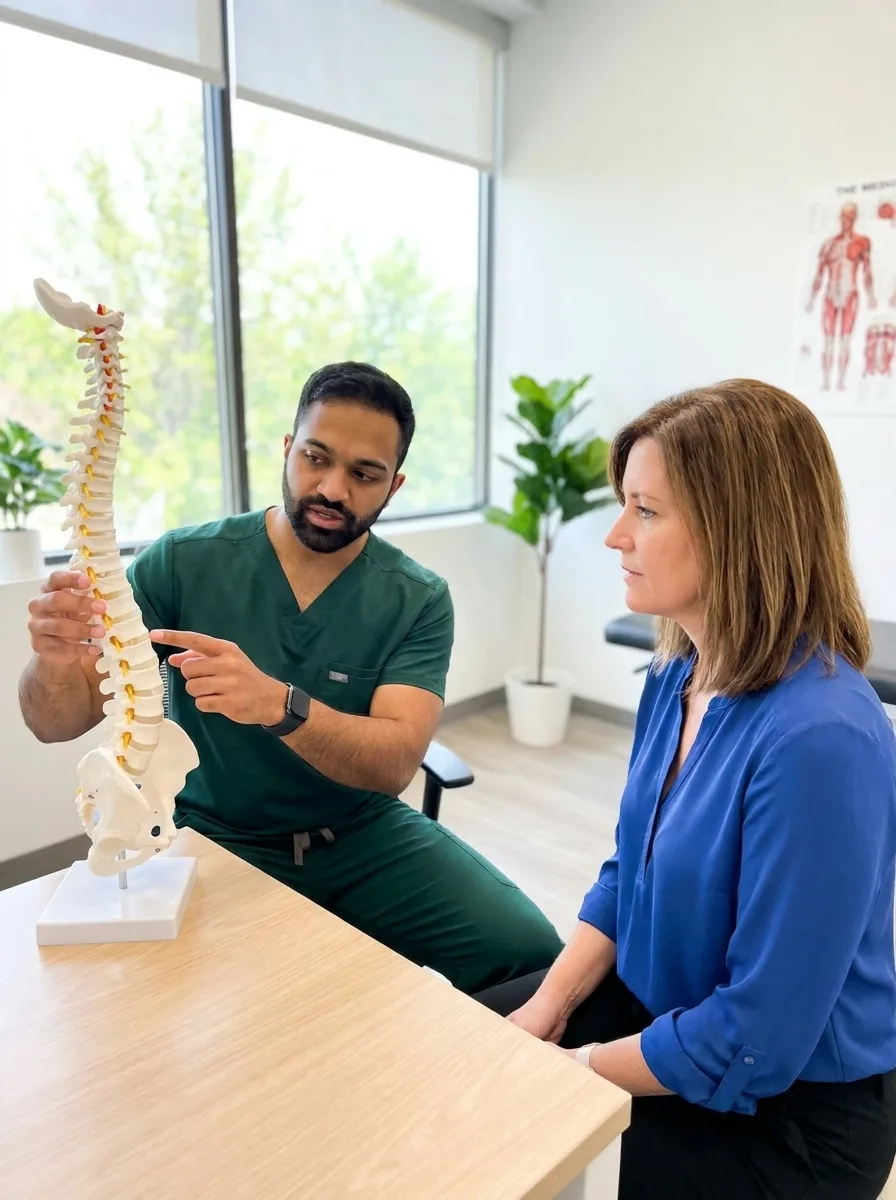
Bertolotti Syndrome is lower back pain caused by an extra joint in your spine that you were born with.
At the bottom of your spine sits your lowest lumbar vertebra, usually the one called L5. In most people it floats freely above the sacrum, the solid bone at the base of your spine.
In people with Bertolotti Syndrome, that lowest vertebra has an oversized wing of bone, called a transverse process, that reaches down and touches or partly fuses with the sacrum or pelvis. This is known as a lumbosacral transitional vertebra, or LSTV.
Where that oversized bone meets the sacrum, it forms a false joint. Doctors call it a pseudoarticulation (a joint nature never meant to be there). Your body didn’t build it to carry load or move, so over time it can get irritated, inflamed, and painful.
How do you know if you have Bertolotti Syndrome?
The pattern is often recognizable once you know what to look for. The pain usually sits low, near your belt line, and tends to favor one side instead of spreading evenly across your back.
Common signs of Bertolotti Syndrome may include:
That last symptom is the telling one. Many people with Bertolotti Syndrome have already been treated for a disc problem or general low back pain with no lasting relief. If your pain keeps coming back and never quite matches the diagnosis you were given, the transitional vertebra is worth ruling in or out.
- Deep, aching lower back pain, often worse on one side
- Pain near the spot where your spine meets your pelvis
- Discomfort that flares with standing, walking, bending, or twisting
- Pain that has lingered for years, often since young adulthood
- Aching that can spread into the buttock or hip
- Stiffness after sitting a while or first thing in the morning
- Pain that earlier treatments never fully explained or fixed
Causes
What are the common causes of Bertolotti Syndrome?
The anatomy itself isn’t caused by anything you did. You were born with the transitional vertebra. It formed while your spine was developing, before birth, and it has been part of you ever since.
So why does the pain often start in your twenties, thirties, or forties instead of in childhood? The false joint and the structures around it slowly take on stress they were never built for. A few things tend to drive it:
- The pseudoarticulation itself gets inflamed from rubbing and carrying load it can’t handle.
- The disc just above the transitional vertebra often wears down faster than normal, because your spine moves differently around the abnormal joint.
- Nearby structures like the facet joints and the sacroiliac joint pick up extra strain as they try to compensate.
Heavy activity, a growth spurt, weight gain, or a minor injury can be the moment the pain finally shows up. The anatomy was there all along. The symptoms just took years to reach a tipping point.

Dr. J explained everything in a simplified way that made me very comfortable, and his staff went above and beyond.


How do we diagnose Bertolotti Syndrome?
Diagnosing Bertolotti Syndrome takes two things. We have to spot the abnormal anatomy, and we have to prove it’s actually the source of your pain. That second part matters, because plenty of people have the anatomy and feel nothing.
The diagnostic injection is what separates a confident diagnosis from a guess. Without that confirmation, the transitional vertebra is only an interesting finding on a scan, and operating on it would be a gamble. The injection tells us whether treating that joint will actually help you.
- Physical exam and history. We press along your lower spine to find the exact spot that hurts, and we ask how your pain behaves through the day.
- X-rays. A standing X-ray shows the transitional vertebra and the false joint clearly. We also use a system called the Castellvi classification, which sorts the anatomy into types based on how the oversized bone connects to the sacrum.
- CT scans. A CT gives us a detailed look at the bone and the false joint, which helps with planning if surgery comes up.
- MRI scans. An MRI rules out disc and nerve problems and can show inflammation right at the false joint.
- Diagnostic injection. We inject numbing medicine straight into the pseudoarticulation. If your pain drops sharply for a few hours, that’s strong evidence the joint is the source.
How do we treat Bertolotti Syndrome?

01
Conservative care
02
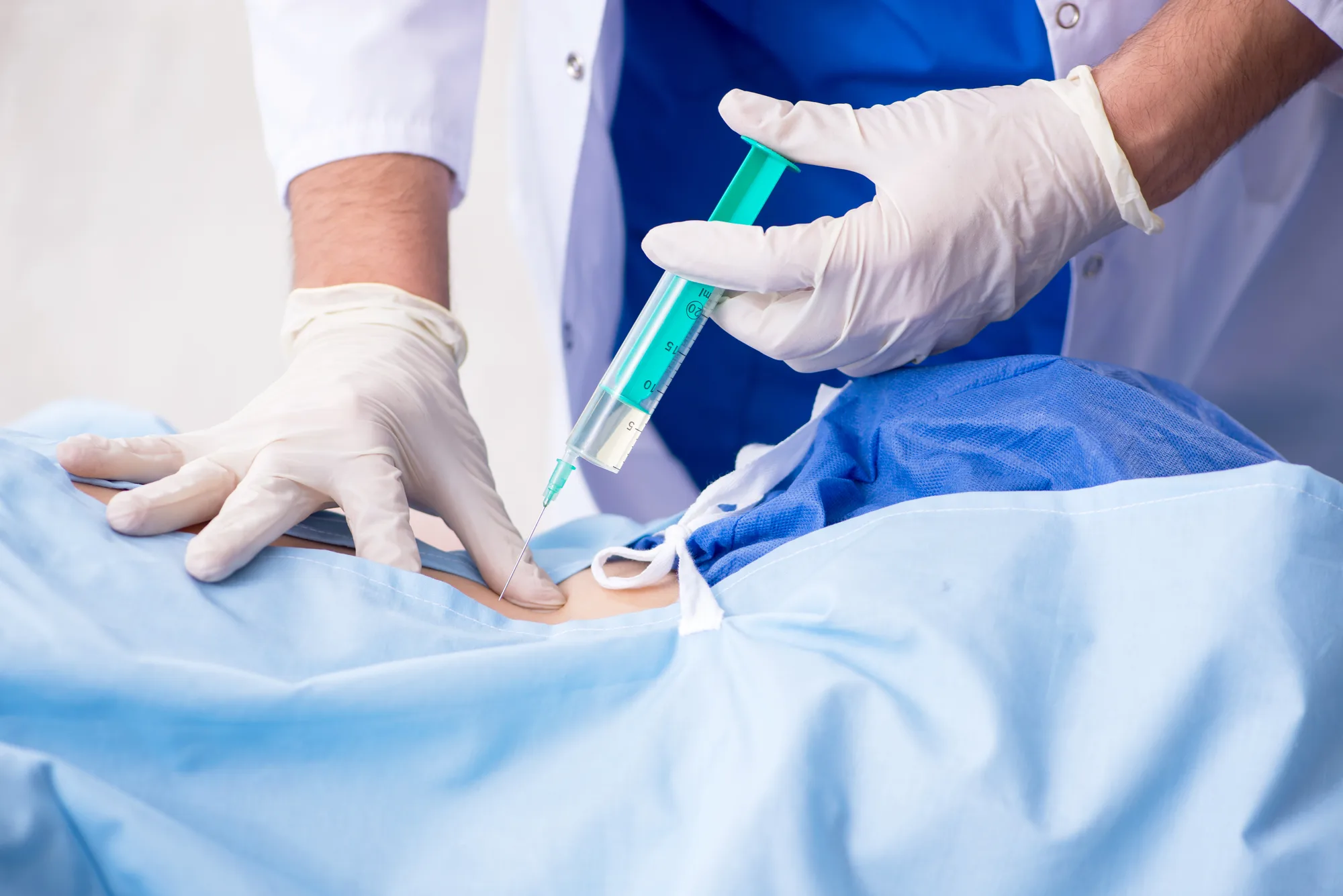
Image-guided injections

03
Surgical resection
Common procedures that we perform to treat Bertolotti Syndrome
Anterior Cervical Discectomy and Fusion
Considering an anterior cervical discectomy and fusion in New Jersey? Learn how the procedure works, who may be a candidate, and what to expect before and after surgery.
Lumbar Microdiscectomy / Laminectomy
Considering a lumbar microdisectomy or laminectomy in New Jersey? Learn how the procedure works, who may be a candidate, and what to expect before and after surgery.
Minimally-Invasive Lumbar Fusion
Considering minimally invasive lumbar fusion in New Jersey? Learn how the procedure works, who may be a candidate, and what to expect before and after surgery.
Can we treat your Bertolotti Syndrome?
We evaluate adults whose lower back pain may be coming from a transitional vertebra, including people who have been told for years that nothing was wrong. The Jey Institute offers Bertolotti Syndrome treatment New Jersey residents can reach from across the region.
Some people only need physical therapy or an occasional injection. Others, once the diagnosis is confirmed, do best with surgical resection. We build the plan around what your exam, imaging, and injection results actually show.
You may be a good candidate for evaluation if:
- You have ongoing one-sided lower back pain that hasn’t responded to standard treatment
- Imaging shows a lumbosacral transitional vertebra
- Your pain eases after a diagnostic injection into the false joint
- Conservative care and injections haven’t given you lasting relief
- You want a clear answer about whether this anatomy is causing your pain

Dr. Shiveindra Jeyamohan
Lead Spinal Neurosurgeon
Why choose the Jey Institute for your Bertolotti Syndrome treatment?
Bertolotti Syndrome is often overlooked, which makes an accurate diagnosis especially important.
At the Jey Institute, we specialize in diagnosing and treating Bertolotti Syndrome and other spinal conditions using image-guided injections and advanced minimally invasive surgical techniques.
We tailor treatment to each patient’s condition, starting with the least invasive option and moving toward surgery only when it is needed.
- 2,200+ Patients served
- 650+ Surgeries performed
Frequently asked questions about Bertolotti Syndrome
Can conservative care actually fix the underlying anatomy?
It won’t change the anatomy itself, but it can do a lot for the symptoms. Physical therapy often helps. And a well-targeted injection right at the area in question works two ways: it gives real pain relief, and it’s one of the best tools we have for confirming the diagnosis in the first place.
Could my back pain actually be from something else?
Absolutely, and it often is. Bertolotti’s is rare, and plenty of patients have other things going on at the same time. That’s exactly why it helps to see someone who’s comfortable across the board, Bertolotti’s, disc problems, nerve compression, and other spinal disorders, so the real source gets sorted out and you get an accurate diagnosis.
Is Bertolotti Syndrome serious?
Not necessarily. It’s not dangerous in the way some spinal problems are, but it can be genuinely painful and wear on you over time.
What’s the success rate of surgery?
Usually somewhere around 75 to 85 percent. The patients who fall into that group tend to be very happy with how things turn out.
Why was this missed by my previous provider?
Bertolotti’s is rare, so it’s not usually the first thing on anyone’s radar. Most of the time we’re looking at the discs and the joints, and the pelvis is easy to skip right over. It’s an honest blind spot, not a careless one.
Locations throughout New Jersey
Dover, NJ
50 Nelson St.
Dover NJ 07801
Clifton, NJ
735 Clifton Avenue
Clifton NJ 07013
Hamilton, NJ
311 Whitehorse Ave.,
Hamilton Township, NJ
08610
Little Silver, NJ
200 White Road,
Little Silver, NJ 07739
Suite 111
West Orange, NJ
414 Eagle Rock Ave,
West Orange, NJ 07052
Suite 304
East Brunswick, NJ
180 Tices Lane
East Brunswick NJ 08816
Suite 106
Local reviews from real patients
Bernice
Eddie
Steve W.
Steven C.
Michelle G.
Verified Patient
Verified Patient
Verified Patient
Verified Patient
Verified Patient
Jim D.
Eric F.